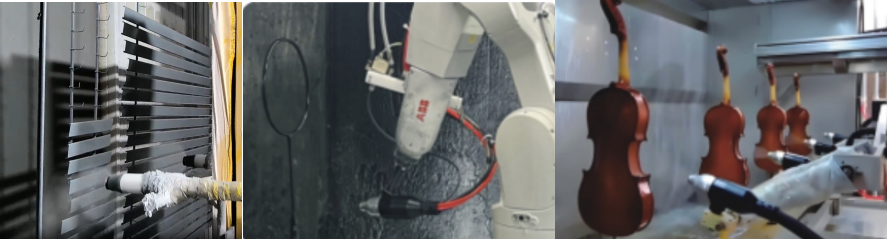
It is possible to clearly differentiate Hongda
electrostatic rotary bell models configured for reciprocator mounting from those designed for robotic arm integration. Most mainstream Hongda electrostatic rotary bell units support both installation scenarios, and the correct configuration can be quickly identified by three key criteria:model suffix codes, structural parameters, and compatibility specifications.
1. Differentiation by Model Suffix
HDA-50T Series
This series provides two dedicated optional versions with distinct suffixes that directly define the applicable working mode, clearly distinguishing models forreciprocator automatic sprayingandrobotic arm automatic spraying. This is the most straightforward and efficient identification method.
HDA-60 Series
The HDA-60 series is a universal rotary bell model without scenario-specific suffix markers. Its applicable installation type (reciprocator or robotic arm) needs to be confirmed by verifying its detailed structural parameters and compatibility configurations.
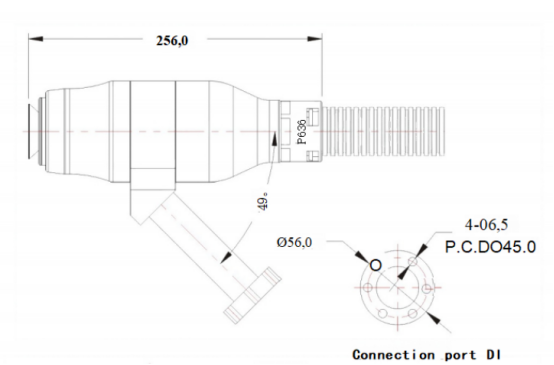
HDA-605Y Electrostatic rotary bell spray gun:
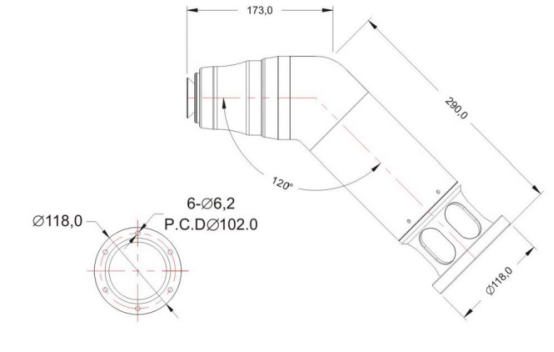
HDA-605R Electrostatic rotary bell spray gun:
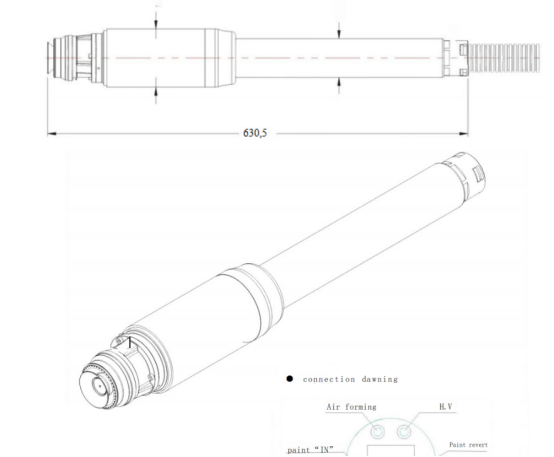
HDA-605H Electrostatic rotary bell spray gun:
Hongda electrostatic rotary bell spray guns are available in two configurations tailored forreciprocator mountingandrobotic arm integration. While most mainstream models support both installation forms, users can accurately distinguish the two versions through three core dimensions:model suffix coding, structural parameters, and application scenario compatibility.
1. Differentiation by Model Suffix
HDA-50T Series
The HDA-50T series adopts differentiated suffix coding design. Two independent versions are available for reciprocator-driven automatic spraying and robotic arm automatic spraying respectively. The model suffix directly indicates the matching equipment type, which serves as the most intuitive and efficient identification method.
The HDA-60 series (including the mainstream HDA-605 rotary bell) is a universal general-purpose model without dedicated scenario suffixes. There is no visual distinction in model coding. To confirm whether it is applicable for reciprocator or robotic arm installation, verification of its internal structure and matching parameter configurations is required.
Robotic Arm Configuration
Reciprocator Configuration
3. Differentiation by Application Scenarios
Mainly applied in 3C electronics, precision hardware and other
high-standard coating industries. It targets workpieces with complex surfaces and special shapes, meeting stringent requirements for coating uniformity, film thickness consistency and full coverage. It realizes fully automated, high-precision intelligent spraying via robot linkage control.
Primarily used for automotive parts, panel furniture, large flat workpieces and mass production scenarios. Oriented to high-capacity industrial production, it relies on reciprocator cycle operation to achieve continuous, high-efficiency batch spraying, balancing excellent coating quality and high production output.
Robotic arm application model
|
Lighter in weight and more compact in size, it meets the payload requirements for robot end-effectors;
it predominantly utilizes air-bearing motors with no-load speeds reaching up to 80,000 rpm,
catering to the high-precision spraying needs of workpieces with complex curved surfaces.
|
Reciprocating machine model
|
It offers enhanced structural stability and flexible settings for paint flow rate ranges; operating speeds
and paint volumes for each stage can be freely adjusted based on the characteristics of flat workpieces,
making it suitable for high-throughput, batch-production flat-surface spraying applications.
|