Collection HDA hda-sl01@hongdapt.com Online message Site Map Hello, welcome to hongda spray-painting machine electric official website!
Sales of HONGDA spraygun We specialized in manufacturing electrostatic spray guns
+86 13622624429

+86 13622624429
Contact person: Ms Croesus
0769-81885105
Phone: +86 13622624429
E-mail: hda-sl01@hongdapt.com
Skype: hongdapt@outlook.com
QQ: 1550167687
Factory: Block A No336, Changqing North Road Chanan Town . dongguan China
Hotline:+86-13622624429
What is the difference between a liquid air electrostatic spray gun and a liquid rotary bell electrostatic spray gun?
The core difference between a liquid air electrostatic spray gun and a liquid rotary bell electrostatic spray gun lies in the atomization method and applicable scenarios: the former relies on compressed air to atomize the paint and is suitable for simple workpieces; the latter achieves centrifugal atomization through a high-speed rotating bell , combined with electrostatic attraction, making it more suitable for complex surfaces, providing more uniform spraying and higher efficiency.
Main Differences Comparison:
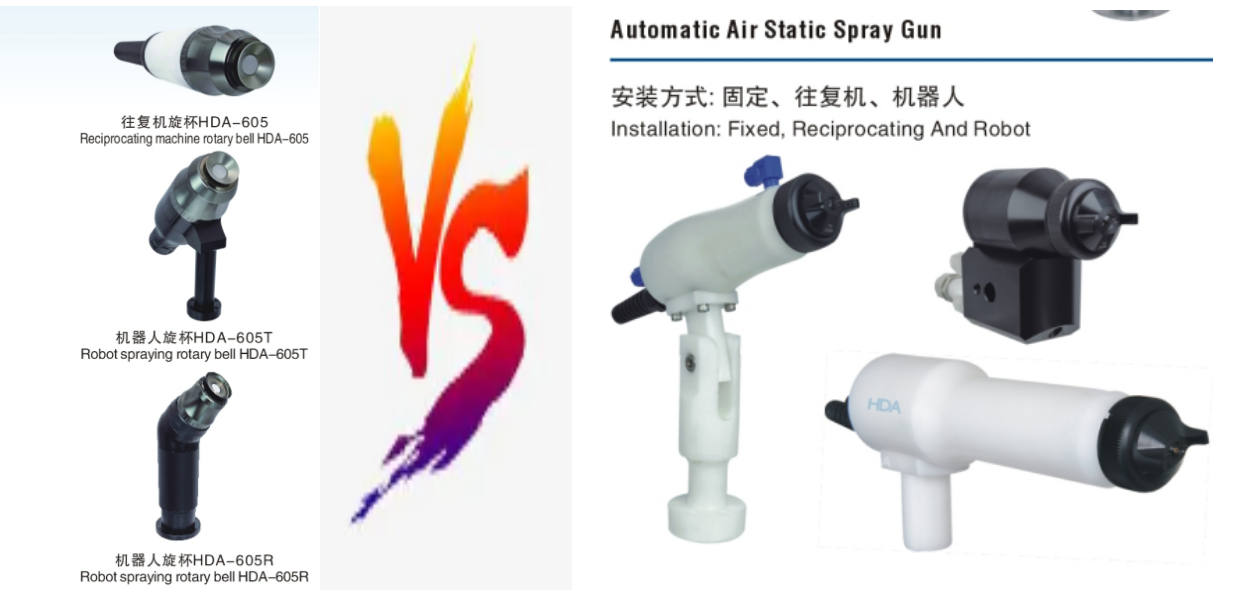
Different working principles
Liquid Air Electrostatic Spray Gun: Uses compressed air to atomize the paint through impact, while a static generator charges the paint particles, causing them to adhere to the grounded workpiece. The degree of atomization depends on air pressure adjustment. Its structure is similar to a traditional air spray gun, but with the added electrostatic function.
Liquid rotary bell electrostatic spray gun: Uses a high-speed rotating metal bell (with speeds up to over 60,000 RPM) to generate strong centrifugal force, flinging the coating out and atomizing it into extremely fine particles, while applying an electrostatic charge, allowing the charged paint mist to precisely adhere to the workpiece surface under the influence of the electric field.
Spray coating effect and uniformity
The air spray gun atomizes relatively coarse particles, the coating uniformity is average, and its coverage ability on edges and recessed areas is weak.
The rotary cup spray gun atomizes more finely, and combined with the electrostatic coating effect, it can achieve 'surround spraying,' covering more than 95% of complex shapes and hard-to-reach areas, resulting in a thinner and more even coating.
Paint utilization and environmental friendliness
The paint utilization rate of a conventional air electrostatic spray gun is about 10%-20% higher than that of a traditional spray gun, but there is still some bounce-back and overspray.
The rotary bell electrostatic spray gun, due to sufficient atomization and strong adhesion, can achieve a paint transfer efficiency of over 85%, which is 10%-15% higher than the industry average, significantly reducing waste and VOC emissions.
Automation Integration and Application Scenarios
Air electrostatic spray guns are mostly used in manual or semi-automatic lines, suitable for flat or simple structured parts, such as household appliance housings and metal sheets.
Rotary bell spray guns are often integrated with robots or reciprocating machines, widely used in high-demand coating fields such as automobile bodies, carbon fiber components, and customized wooden doors.
Operation and Maintenance
Air spray guns have a simple structure, are easy to maintain, and have lower costs.
Rotary bell spray guns have a precise structure, requiring regular cleaning of the bell edges and checking the bearing condition. Maintenance demands are higher, but in the long term, they more significantly save on paint costs.
Which type of spray gun is more suitable for fine spraying:
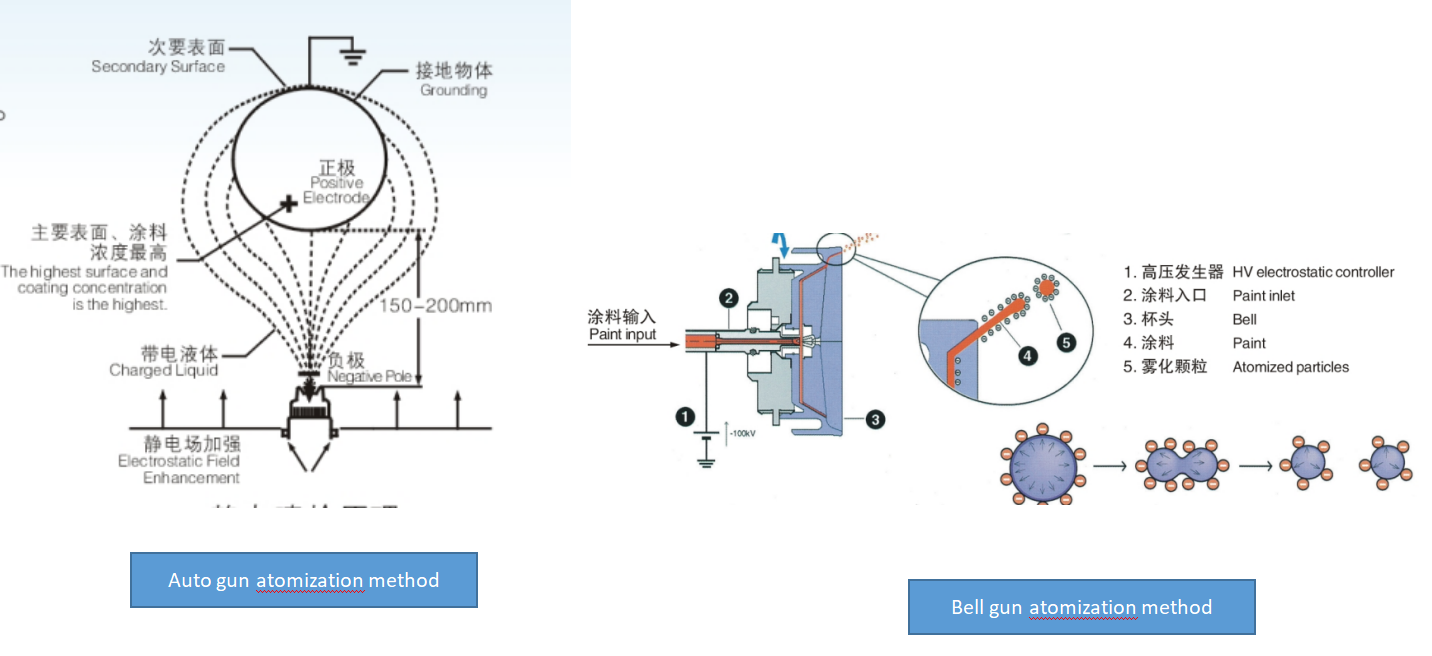
Liquid rotary bell electrostatic spray guns are more suitable for fine spraying.
In scenarios where high requirements are placed on coating uniformity, detail coverage, and surface quality, liquid rotary bell electrostatic spray guns, with their dual advantages of centrifugal atomization and electrostatic attraction, can achieve a finer and more precise coating effect.
Why is a rotary bell spray gun more suitable for fine spraying? The atomization is finer.
The liquid rotary bell electrostatic spray gun spins at high speed (up to 30,000–60,000 RPM) to fling the coating, forming extremely fine and uniformly sized mist droplets, which is far superior to the atomization method of air guns that rely on airflow impact. Finer droplets mean smoother coating transitions, effectively reducing surface defects such as orange peel and particles, and improving the texture of the paint film. The electrostatic wrapping effect is strong, providing better coverage of hard-to-reach areas.
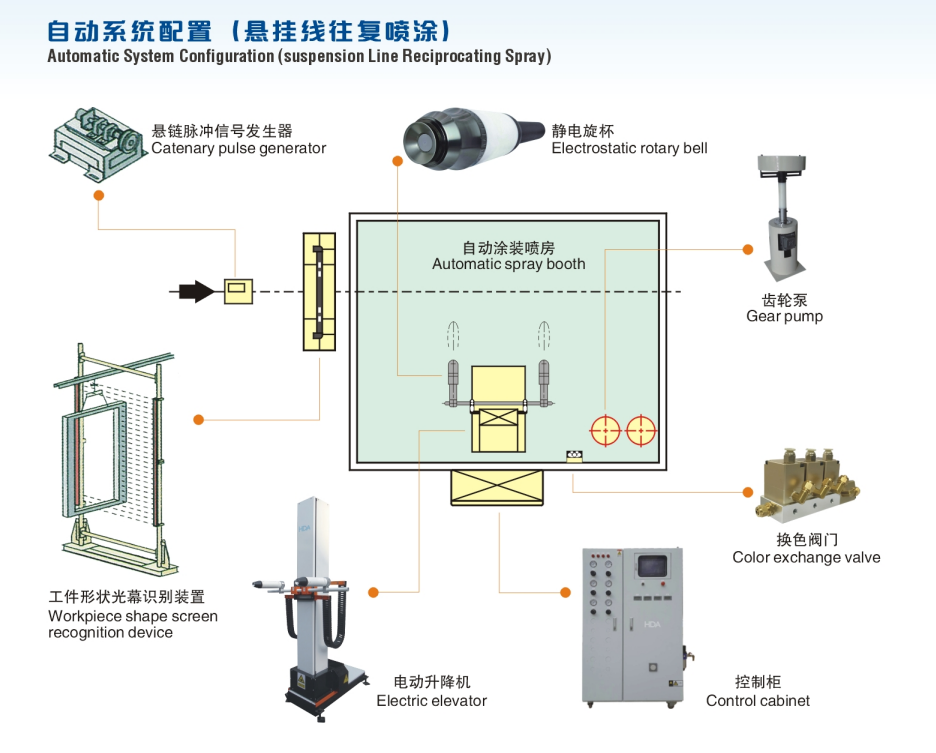
Under the action of the electrostatic field, charged paint mist will 'actively adhere' to the surface of the workpiece, and can even wrap around to spray the back and recessed areas, achieving uniform coverage within the Faraday cage effect. This is crucial for fine spraying of complex curved surfaces, hollow structures, or precision components (such as automotive trim and electronic housings). The coating thickness is precisely controlled with high consistency.
Rotating bell spray guns are often integrated with automation equipment (such as robots and reciprocators) and, together with digital control systems, can precisely adjust flow rate, rotation speed, and voltage, ensuring minimal coating thickness variation for each product. In contrast, air spray guns rely more on the operator's experience, making consistency harder to guarantee. The coating material utilization is high, making it suitable for high-cost coating operations.
The paint transfer efficiency of rotary bell spray guns generally exceeds 80%, which is 10%–15% higher compared to air electrostatic spray guns. When using expensive pearl paint, clear coats, and other fine coatings, it can significantly reduce material costs.
It is widely used in high-end fine coating fields.
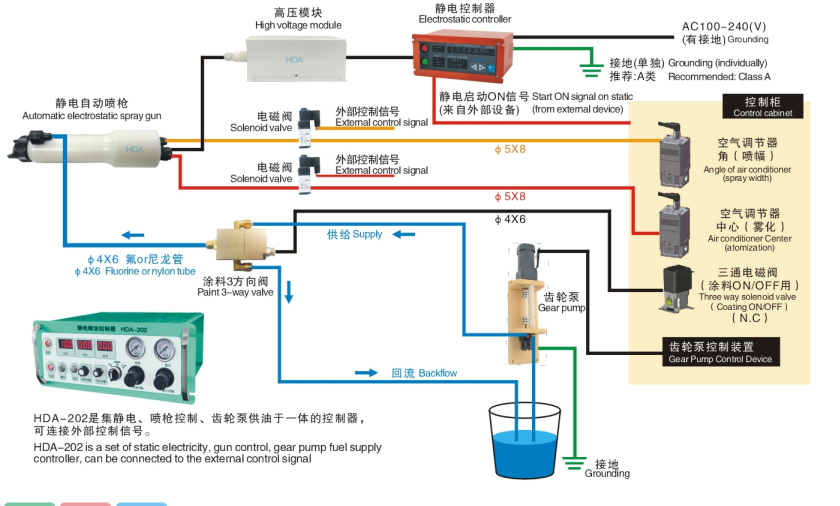
Industries such as automotive topcoats, 3C electronic products, high-end furniture, and medical devices, where surface quality requirements are stringent, commonly adopt rotary bell electrostatic spraying as the standard process.
In contrast, although liquid air electrostatic spray guns have a simple structure and are easy to maintain, they still struggle to meet the high precision, uniform coating, and automation requirements needed for demanding fine spraying tasks.